Several tofu cat litter brands include “flushable” on their packaging. The granules do dissolve in water more readily than clay or crystal, and demonstrations showing tofu litter breaking apart in a glass of water are common in product marketing. But whether a litter dissolves in a glass and whether it can safely go down a toilet and through a municipal sewer system are two different questions.
This article covers what manufacturers claim, what plumbing professionals report, what municipal regulations say, and the environmental concern that applies to all cat litter — regardless of material.
What Manufacturers Claim
Many tofu litter brands state that their product is flushable in small amounts. The typical instruction is to flush one clump at a time, allow it to soak in the toilet bowl for a few minutes before flushing, and avoid flushing large volumes at once.
Tuft & Paw notes that tofu litter does break down in water faster than clay-based products. The soybean fiber and starch that hold the granules together soften and separate when submerged, which is the basis for flushability claims.
Lady N US similarly describes tofu litter as water-soluble and states that it can be disposed of via toilet in small quantities.
These claims are made by the litter manufacturers themselves. Independent plumbing and municipal assessments tell a more complicated story.
What Plumbing Professionals Report
Plumbers generally advise against flushing any solid material other than toilet paper and human waste down a toilet. This is not specific to cat litter — it includes products marketed as “flushable” such as certain wipes, hygiene products, and pet waste.
The concern is straightforward: toilets and household plumbing are designed for a limited range of materials. Cat litter — even tofu litter that dissolves in water — adds volume and organic matter to the waste stream. Plumbing professionals report several potential issues:
Pipe buildup. Even if tofu litter dissolves partially in the toilet bowl, it may not fully break down before reaching narrower sections of household plumbing. Older homes with cast iron or clay drain pipes are particularly vulnerable to buildup and partial blockages.
Toilet clogs. Flushing more than a small clump at a time can overwhelm a standard toilet’s flush capacity. The dissolved litter creates a thick slurry that may not clear the trap fully, especially in low-flow toilets (1.6 gallons per flush or less, which is the standard in U.S. homes built after 1994).
Septic system issues. Households on septic systems face additional risks. Septic tanks rely on bacterial decomposition of waste. Adding soybean fiber and starch introduces organic matter that the bacterial ecosystem is not designed to process. Over time, this can increase the rate at which the tank fills with solids, potentially leading to more frequent pumping or system backups.
Plumbing trade sources generally maintain a simple position: the only things that belong in a toilet are human waste and toilet paper. Everything else — regardless of what the packaging says — increases the risk of problems.
What Municipalities Say
Several U.S. cities and states have explicit policies against flushing any cat litter — and the reasons go beyond plumbing.
Toxoplasma gondii: The Core Environmental Concern
The primary reason municipalities restrict or discourage flushing cat waste is Toxoplasma gondii, a parasite that can be present in cat feces. Cats — particularly outdoor cats or those that hunt — are the definitive host for T. gondii. Infected cats shed oocysts (parasite eggs) in their feces for a period after initial infection.
The critical problem: standard municipal wastewater treatment processes do not reliably kill T. gondii oocysts. Research has documented the parasite surviving treatment and entering waterways, where it can infect marine wildlife. Studies on the California coast, for example, have linked T. gondii in sea otter populations to wastewater outflows.
This is not a concern unique to tofu litter. It applies to every type of cat litter and to cat feces itself, regardless of how it is disposed of. The litter material is irrelevant — the parasite is in the feces, not the litter.
Specific Municipal Policies
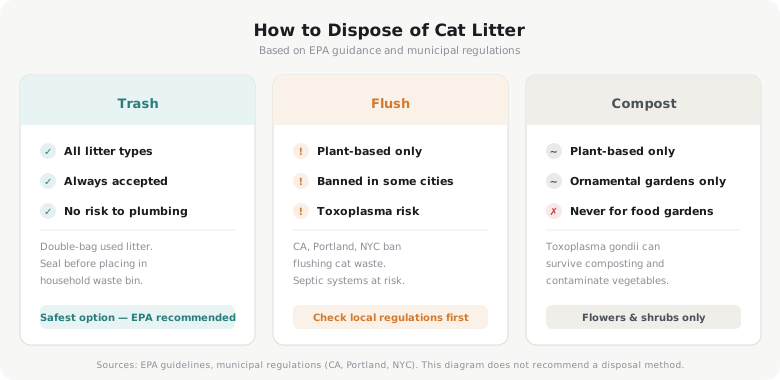
California. State law (AB 2485, signed in 2006) requires cat litter packaging sold in California to carry a label warning against flushing cat feces. The law cites the risk to marine wildlife from T. gondii.
Portland, Oregon. The city’s Bureau of Environmental Services advises residents not to flush cat litter or cat waste of any kind.
New York City. The NYC Department of Environmental Protection advises against flushing cat litter. The city’s combined sewer system — which handles both stormwater and sewage — is particularly sensitive to additional solid material.
San Francisco. San Francisco Public Utilities Commission similarly advises residents to bag cat waste and dispose of it in household trash, not toilets.
These policies do not distinguish between litter types. Clay, tofu, pine, corn — the municipal guidance applies to all of them equally because the underlying concern is biological (T. gondii), not material.
What the EPA Says
The U.S. Environmental Protection Agency does not have a specific regulation on flushing cat litter, but the agency’s general guidance on what belongs in sewer systems is narrow: human waste and toilet paper. The EPA’s broader position on pollutants entering waterways through sewer systems supports the municipal-level restrictions described above.
The EPA has also funded research on Toxoplasma gondii in waterways, particularly in relation to wildlife impacts along the Pacific Coast. This research informs state-level policies like California’s labeling law.
Septic Systems: A Separate Set of Concerns
Approximately 20% of U.S. homes rely on septic systems rather than municipal sewer connections. For these households, flushing cat litter of any type introduces specific risks:
Solid accumulation. Septic tanks work by separating solids from liquids. Solids settle to the bottom and are broken down slowly by bacteria. Adding cat litter — even biodegradable tofu litter — increases the solid load. This can accelerate the need for tank pumping.
Bacterial balance disruption. Septic systems rely on specific bacterial populations to break down waste. Introducing large amounts of soybean fiber changes the organic composition of the tank contents, potentially shifting the bacterial balance in ways that reduce efficiency.
Drain field problems. If solids escape the tank and enter the drain field (the underground area where liquid effluent is dispersed into soil), they can clog the field’s distribution pipes. Drain field failure is one of the most expensive septic system repairs.
Septic system professionals uniformly advise against flushing any cat litter.
How Tofu Litter Compares to Other Types on Flushability
Among all litter types, tofu litter has the strongest flushability claim because it physically dissolves in water. Other litter types fare worse:
- Clay (bentonite): Expands in water. Flushing clay litter can cause severe clogs.
- Crystal/silica: Does not dissolve. Should never be flushed.
- Pine pellets: Disintegrate into sawdust in water, creating a pulpy mass that can clog pipes.
- Walnut and corn: Some brands claim limited flushability, but the same municipal and plumbing concerns apply.
Tofu litter is more flushable than other litter types in a purely mechanical sense. But “more flushable” does not mean “safe to flush” from a plumbing, municipal, or environmental perspective.
What This Means in Practice
The gap between “this product dissolves in water” and “this product is safe to flush in all plumbing systems, sewer configurations, and regulatory environments” is significant. Cat owners considering flushing tofu litter face a situation where:
- The manufacturer says it is flushable (in small amounts)
- Plumbing professionals generally advise against flushing any litter
- Multiple municipalities explicitly prohibit flushing cat waste
- Environmental research documents a real parasite transmission pathway through flushed cat feces
- Septic system owners face additional mechanical risks
Some cat owners report flushing small amounts of tofu litter without incident over extended periods. Others report clogs, particularly in older homes or with low-flow toilets. The outcomes appear to depend heavily on the specific plumbing infrastructure, the frequency and volume of flushing, and local wastewater treatment capabilities.
Alternative Disposal Methods
For cat owners who chose tofu litter partly because of its flushability and are reconsidering that approach, the standard alternatives include:
Bagging and trash disposal. The method endorsed by most municipalities. Used litter goes into a bag, sealed, and placed in household garbage. Tofu litter, being lighter than clay, makes this less physically demanding.
Composting. Because tofu litter is plant-based, it is technically compostable. However, composting cat feces introduces T. gondii risk to the compost. Most composting guides advise against composting pet waste in compost that will be used on edible gardens. Composting for ornamental garden use may be acceptable depending on local guidelines and composting temperatures achieved.
Green waste programs. Some municipalities accept biodegradable cat litter (without feces) in green waste or yard waste bins. This varies by location and requires checking local regulations.
For background on tofu litter in general, see What Is Tofu Cat Litter?.
Sources:
- Tuft & Paw — Everything You Need to Know About Tofu Cat Litter
- Lady N US — What Is Cat Tofu Litter?
- Consumer Reports — Should You Be Using Cat Litter Made of Tofu?
- Hill’s Pet — Types of Cat Litter and How to Choose the Right One
Consult a veterinarian for questions about your cat’s health and litter needs.
Sources
Frequently Asked Questions
Can you flush tofu cat litter down the toilet?
While tofu litter dissolves in water, plumbing professionals advise against flushing it. Flushing risks pipe buildup, toilet clogs, and septic system issues, and multiple municipalities explicitly prohibit flushing cat waste due to Toxoplasma gondii parasite risk to marine wildlife.
What is Toxoplasma gondii and why does it matter for flushing?
Toxoplasma gondii is a parasite in cat feces that survives municipal wastewater treatment and enters waterways, infecting marine wildlife. Studies document the parasite in sea otters from California wastewater outflows.
What does California law say about flushing cat litter?
State law AB 2485 signed in 2006 requires cat litter packaging sold in California to carry a warning against flushing cat feces due to the risk to marine wildlife from Toxoplasma gondii.